Call us now :08045805108
 Send Inquiry
 Send Inquiry
Solid Spherical Activated Alumina Balls
Price 85 INR/ Kilograms
MOQ : 25 Kilograms
Solid Spherical Activated Alumina Balls Specification
- Taste
- Odorless and tasteless
- Melting Point
- ~ 2040C
- Other Names
- Activated Aluminium Oxide, Alumina Spheres
- Molecular Formula
- Al2O3
- Purity
- 92% Al2O3
- Molecular Weight
- 101.96 g/mol
- Structural Formula
- Al2O3
- Storage
- Store in dry, ventilated warehouses, away from moisture
- Solubility
- Insoluble in water, soluble in strong acids and alkalis
- Density
- 3.9 Gram per cubic centimeter(g/cm3)
- Smell
- Odorless
- Poisonous
- Yes
- Ph Level
- 8-9 (in 5% water suspension)
- Refractive Rate
- ~1.76
- Shape
- Spherical
- Form
- Solid
- HS Code
- 28182090
- Boiling point
- N/A (sublimates at high temperature)
- Classification
- Oxides
- Chemical Name
- Aluminium Oxide
- CAS No
- 1344-28-1
- EINECS No
- 215-691-6
- Grade
- Industrial Grade
- Standard
- As per relevant industrial or customer requirements
- Type
- Solid Spherical Activated Alumina Balls
- Usage
- Absorbent, drying and purification
- Main Material
- Activated Alumina (Al2O3)
- Application
- Industrial
- Non Toxic
- Yes
- Regeneration
- Can be regenerated by heating
- Attrition Loss
- 0.1%
- Crush Strength
- 100 N (for 4mm) balls
- Pore Volume
- 0.40 - 0.50 cm3/g
- Thermal Stability
- Excellent
- Surface Area (BET)
- 300 m2/g
- Particle Size
- 2-5 mm, 3-5 mm, 4-6 mm (as per requirement)
- Color
- White
Solid Spherical Activated Alumina Balls Trade Information
- Minimum Order Quantity
- 25 Kilograms
- Supply Ability
- 50000 Kilograms Per Month
- Delivery Time
- 4 Week
- Sample Available
- Yes
- Sample Policy
- Free samples available with shipping and taxes paid by the buyer
- Packaging Details
- HDPE BAGS / JUMBO BAGS / METAL DRUMS
- Main Export Market(s)
- Western Europe, Asia, Australia, Eastern Europe, Middle East, Central America, South America, North America, Africa
- Main Domestic Market
- All India
- Certifications
- ISO 9001:2015
Solid Spherical Activated Alumina Balls About
Uses :
Catalyst applications
Activated alumina is used for a wide range ofadsorbent and catalyst applications including the adsorption of catalysts inpolyethylene production, in hydrogen peroxide production,as a selective adsorbent for many chemicals including arsenic, fluoride, in sulfur removal from fluid streams (Claus Catalystprocess).
Desiccant
Used as a desiccant, it works by a process called adsorption.The water in the air actually sticks to the alumina itself in between the tinypassages as the air passes through them. The water molecules become trapped sothat the air is dried out as it passes through the filter. This process isreversible. If the alumina desiccant is heated to approx. 200 Deg. C, it will releasethe trapped water. This process is called regenerating thedesiccant.
Fluoride adsorbent
Activated alumina is also widely used to removefluoride from drinking water. Activated alumina filters can easily reducefluoride levels from 10 ppm to less than 1 ppm.
Defluorination
Defluorination is the downward adjustment of the level of fluoride in drinking water. Activated Alumina processis one of the widely used adsorption methods for the defluoridation of drinkingwater.
Chemisorbent
Activated aluminaimpregnated with potassium permanganate (KMNO4) media (alsocalled potassium permanganate activated alumina) is a chemisorbent, filteringby adsorption and then oxidation, and has a low pressure drop due to itsuniform size and spherical shape. It is useful in removing Hydrogen Sulfide (H2S),Sulfur Dioxide (SO2), Nitrogen Dioxide (NO2), Mercaptans, as well as lightorganics from airstreams. It highly adsorb ethylene, so it is as ethylenefilter or ethylene adsorber.
Superior Adsorption for Industrial Needs
Activated alumina balls deliver outstanding moisture and impurity removal thanks to their high surface area and tailored pore volume. Widely used for air and gas drying, water purification, and as an adsorbent in chemical processes, their consistent performance is trusted by diverse industries. The product's stability and durability make it a versatile and dependable choice for continuous operation.
Rigorous Quality and Safety Standards
Manufactured according to strict requirements, these spherical alumina balls are non-toxic, odorless, and tasteless. The high crush strength and low attrition rate guarantee minimal dusting even under mechanical stress. Their safe handling and storage-requiring only dry, ventilated warehouses-simplify logistics and help maintain product integrity throughout transit and use.
FAQ's of Solid Spherical Activated Alumina Balls:
Q: How are solid spherical activated alumina balls used in industrial applications?
A: These alumina balls are primarily employed as absorbents for drying gases and liquids, removing moisture, and purifying process streams. Their high surface area and tailored pore structure enable efficient adsorption in air and gas drying, water treatment, and catalyst support processes.Q: What is the regeneration process for activated alumina balls?
A: Activated alumina balls can be regenerated through thermal heating. By applying hot air or inert gas at elevated temperatures, absorbed moisture or contaminants are removed, allowing the alumina balls to be reused effectively in ongoing operations.Q: When should activated alumina balls be replaced or regenerated?
A: Replacement or regeneration is recommended when adsorption efficiency noticeably decreases or operational pressure drop increases. The frequency depends on operating conditions and the concentration of impurities in the treated stream.Q: Where should solid spherical activated alumina balls be stored for maximum shelf life?
A: They should be stored in dry, well-ventilated warehouses, away from sources of moisture. Proper storage helps prevent premature absorption of atmospheric humidity and maintains the adsorbent's effectiveness.Q: What benefits do these alumina balls offer compared to alternative adsorbents?
A: Solid spherical activated alumina balls provide excellent mechanical strength, thermal stability, and low attrition rates, resulting in long service life and minimal dust generation. Their ability to be regenerated makes them cost-effective and environmentally friendly compared to some single-use adsorbents.Q: How do the varying particle sizes impact application performance?
A: Selecting different particle sizes (2-5 mm, 3-5 mm, or 4-6 mm) balances the required surface area and pressure drop for specific processes. Smaller particles offer higher surface area for fast adsorption, while larger particles enable lower pressure drops and improved flow rates in packed beds.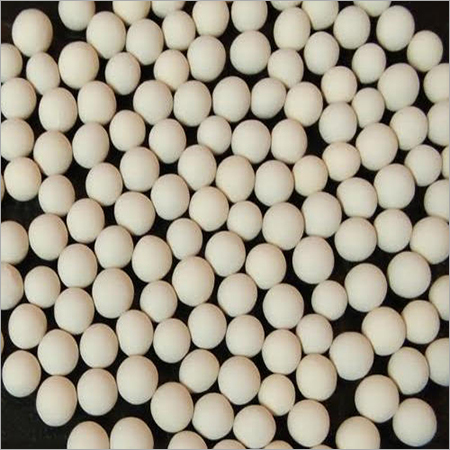
Tell us about your requirement

Price:
Quantity
Select Unit
- 50
- 100
- 200
- 250
- 500
- 1000+
Additional detail
Mobile number
Email

More Products in Activated Alumina Category
Adsorbent Activated Alumina
Price 80 INR / Kilograms
Minimum Order Quantity : 40 Kilograms
Storage : Room Temperature
Application : medicine
Purity : 100%
Physical Form : Solid
Activated Alumina Balls
Price 115 INR / Kilograms
Minimum Order Quantity : 40 Kilograms
Storage : Room Temperature
Application : medicine
Purity : 100%
Physical Form : Solid
Round Activated Alumina
Price 125 INR / Kilograms
Minimum Order Quantity : 40 Kilograms
Storage : Room Temperature
Application : medicine
Purity : 100%
Physical Form : Solid
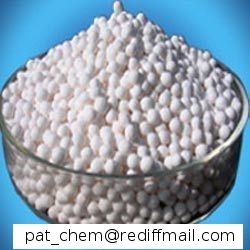
Activated Alumina
Price 125 INR / Kilograms
Minimum Order Quantity : 40 Kilograms
Storage : Room Temperature
Application : medicine
Purity : 100%
Physical Form : Solid

 Send Inquiry
Our Products

B/30, M.P. Shah Industrial Estate, Saru Section Road,Jamnagar - 361002, Gujarat, India

Mr. Paras
(Proprietor)
Mobile :08045805108
 Send Inquiry
 Send SMS
Developed and Managed by Infocom Network Private Limited.
 English
 Spanish
 French
 German
 Italian
 Chinese (Simplified)
 Japanese
 Korean
 Arabic
 Portuguese